I work for a SaaS company with a database of around 200,000 users, all managed through Mailchimp.
Our email strategy was built around supporting and engaging those users. We invited them to product webinars to help them upskill and improve retention, kept them informed about new releases, and sent a monthly newsletter rounding up blogs, webinars, and company updates. New users also received onboarding emails with tutorials to help them get started.
For over 6 years, it worked really well. Engagement was strong, and everything was moving in the right direction.
Until it wasn’t.
Around April 2025, things changed.
And I started to notice. Things were no longer working; results were down. It meant that I had to fix it. So here’s what I did:
Stage 1: Investigation
I started by looking at the campaigns we were running. I felt our onboarding campaign was the best place to start. We sent emails as soon as a user signed up, with tutorials that would help them to get started with the tool. So engagement has always been high.
And here I detected the first problem. Our open rates went from over 40% to just 10% between April and August. Our click rates remained steady at around 2-3%.
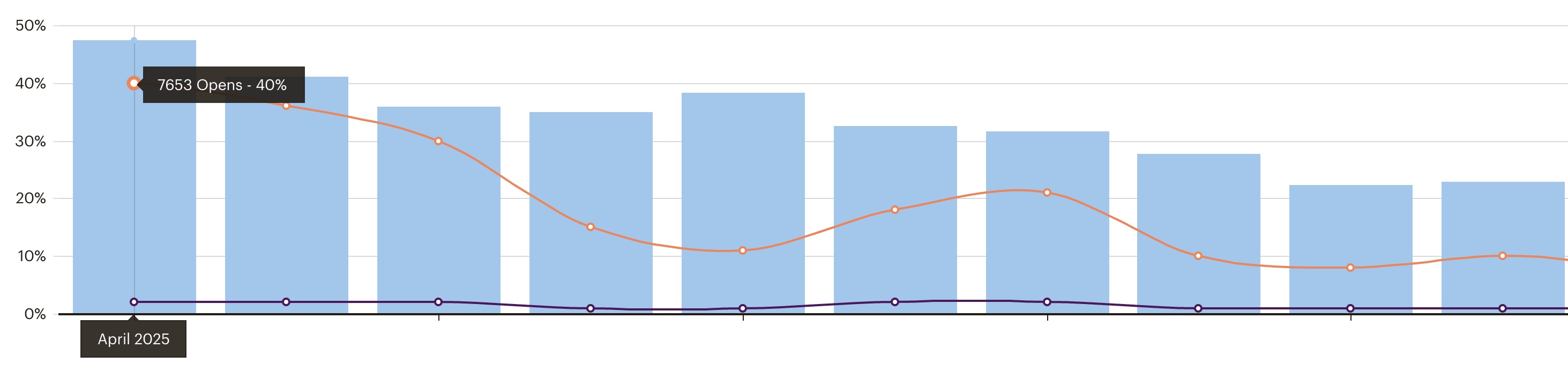
Why was this? After lots of investigation, it seemed that Email service providers improved their spam filters around April 2025. And it impacted us. Deliverability fell. Many of our emails were Gmail addresses and they were getting filtered out into non-primary inboxes. At least this was our gut instinct.
Stage 2: Checks
To rule out anything more sinister, we checked that our email domain was verified and our domain reputation. I tested a few tools, including Warmly to do an email deliverability test.
Everything came out good, we had a good sender reputation and deliverability score. It seemed we were just not hitting the right inbox. Or, if we were, our messaging was off.
Stage 3: Testing
I spoke to Mailchimp. I wanted to see what they suggested. They agreed that Spam filters were the most significant issue we were facing, and recommended a 3-month project to improve our sender reputation and try to get back into primary inboxes.
Test 1
- Send our webinar and product update emails only to users who have opened our emails within the past 3 months, and have a contact rating of more than 1 star
- Keep our email sends regular and consistent
- Do this for a minimum of 1 month
Results: Our open rates climb back up. Our big sends went out to 40k instead of 120k but our open rate went from a 5% to a 20% open rate.
Test 2
- After 2 months (we gave our first test a little longer, in the hope of improving our trust score) try sending to our whole database again.
Results: Open rates back down to around 5%. So Test 1 hadn’t impacted our reputation or trust scores. We were still not getting seen by a large proportion of our audience.
Test 3
I wanted to get to the 80k of our audience that hadn’t been opening our emails in the last 3 months. Were the email providers correctly putting our emails in non-primary inboxes? And were people interested in our content if we could get it seen? I wanted to know whether Mailchimp or our content was the problem. Test 3 was to manually send 3.5k emails out for a webinar. So I took 3.5k of unengaged data and invited them to a webinar. I tested this against a Mailchimp send to the remaining 77k. The results were stark:
- Mailchimp engaged audience = 0.25% registration rate
- Mailchimp non-engaged audience. = 0.12% registration rate
- Manual email ( to non-engaged users) = 1.95% registration rate
What a difference. It confirmed that I could be onto something with the email platform we were sending from.
Test 4
It isn’t possible to send all of our emails manually, which would be the best way of improving deliverability. So I looked at alternatives to Mailchimp, and was told about Loops.so.
I sent the next webinar email to 6.7k users who had not opened a single Mailchimp email in the past 6 months.
- Results: 12% open rate, 1% click rate
We had just reached 810 people who weren’t seeing our emails before.
To me, this was the evidence I needed to prove that the Mailchimp platform is the biggest barrier to our email deliverability. Moving to a different platform isn’t just an option, but something we should prioritise if we want our email marketing to perform better and drive stronger results.
Stage 4: Changing email platform
My next focus is to ensure a smooth transition from Mailchimp to Loops. It’s a process that will take time, but getting it right is essential, especially with users and their experience at the centre of every decision.
I expect this to be around a six-month journey once we begin, and it will require careful planning and close collaboration across the whole team. Every step needs to be considered deliberately to ensure the user journey remains seamless throughout.
Summary
If your email deliverability is declining, don’t assume the platform is to blame. Switching systems is a major time investment, so exhaust every other option first. Only then can you make an informed decision.
In our case we don’t want to move from Mailchimp. Their support has been solid, and our account manager has been great, regularly jumping on calls with me each month to help work through issues. But at some point, you do have to accept when it’s time to make your data work harder for you.
B2B data sources: Comparison of the top players.
Need help with your email deliverability? Get in touch.