
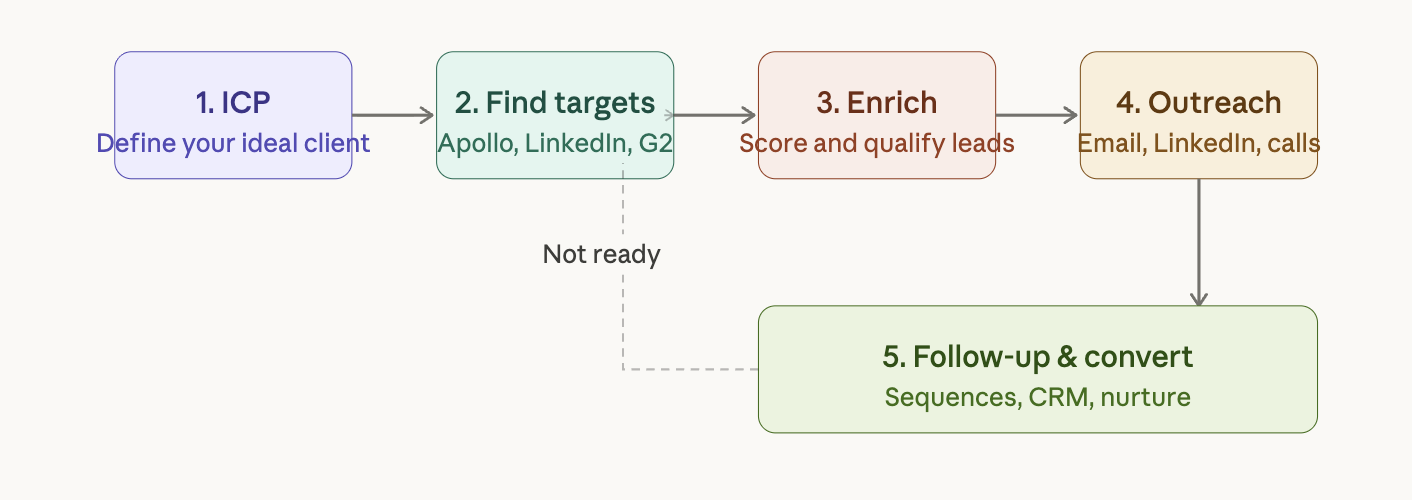
2. Click on Stage 1: Define your market.
Claude will ask you a series of questions from verticals you work in to the decision maker who has typically hired you to help you to identify your ICP. The great thing about Claude is that it will give you pointers as you go, on what to consider when answering the questions around your ICP. Here’s an example of one I did for my business.
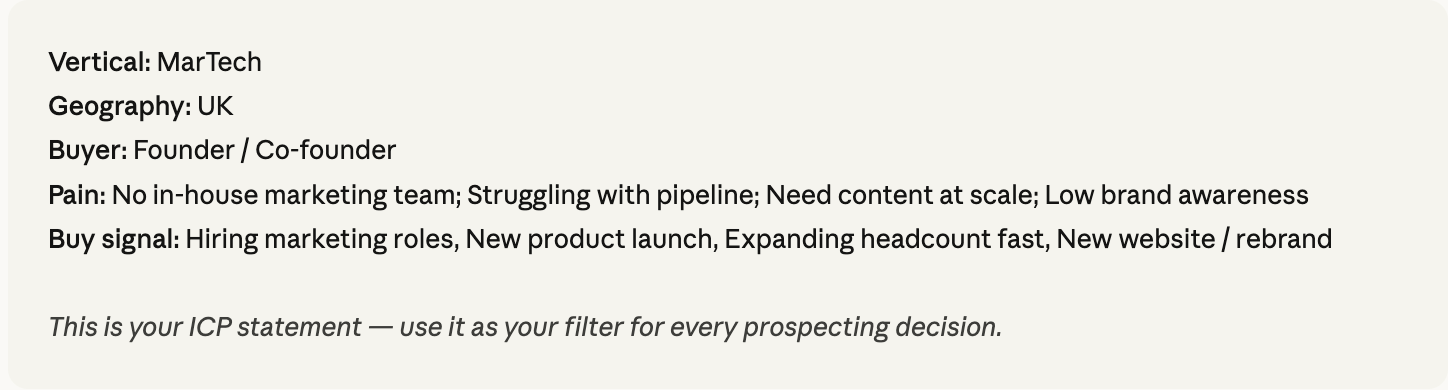
3. Click on ‘Find ICP prospects.’
Claude will go away and show you how to find prospects using tools like LinkedIn, Apollo, Dux-Soup, Crunchbase, Hunter, and Google Alerts to find and enrich your list of prospects. See our review of the top b2b data sources.
If you have subscriptions for specific tools, you can ask Claude to include them, along with how to build them into your workflow, to create the perfect target list for you.
Claude will walk you through specific instructions to carry out within each tool to access your perfect list of ICPs.
In my instance Claude recommends: The golden combination for a lean freelance setup is: Apollo (list building) + LinkedIn Sales Nav (contact finding) + Hunter (email verification) + Google Alerts (signals). That gets you 80% of the way there without committing to expensive tools before you’ve validated the process.
However, as I use Dux-Soup I will ask it to include Dux-Soup which allows me to download email addresses from LinkedIn contacts instead of using Apollo and Hunter- skipping the cost of these two subscriptions.
Tip: A Dux-Soup Pro subscription is enough to provide data and email addresses of your connections. If you send a connection invitation to your list and they accept, you can download their email address for free, and as they have already accepted your connection invitation, they are already a warmer lead.
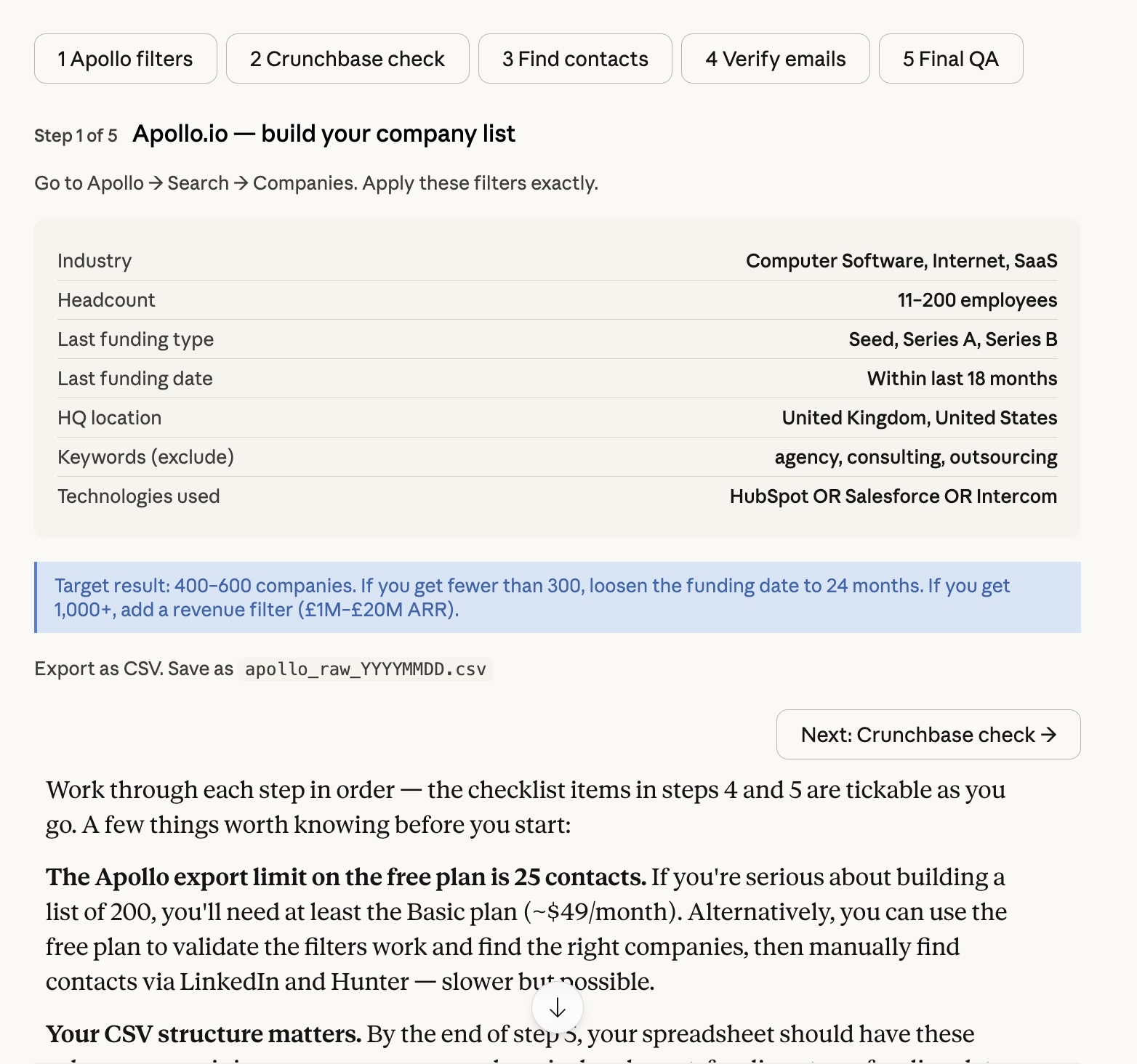
4. Build your prospect list
Claude will give you a clear workflow on how to build your lists – here it shows a 5-step process, along with handy tips along the way to help you.
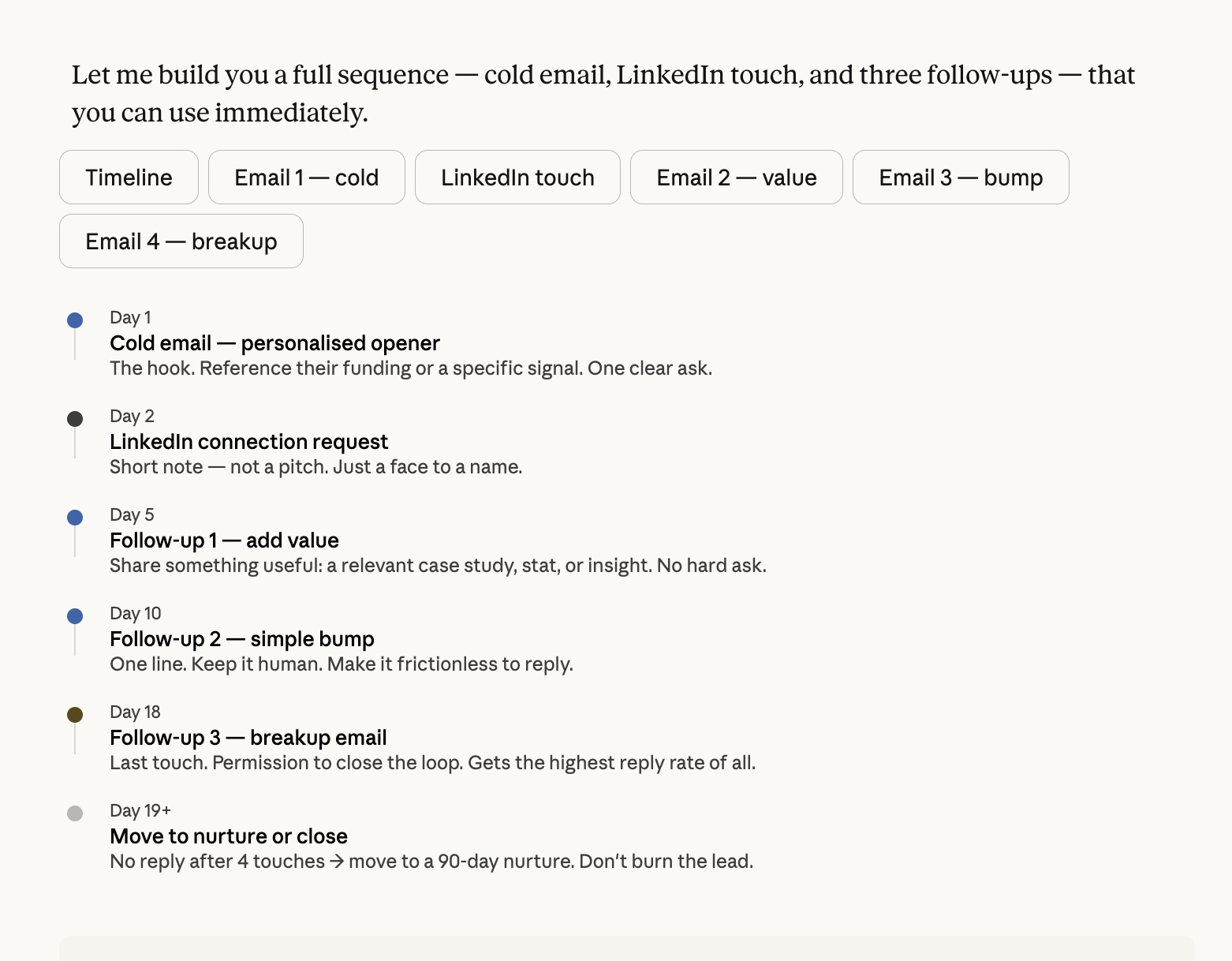
5. Build your campaign sequence
Claude will then build your campaign sequence for you. Here is what it recommends for me:
Then it gives you the copy for each step that you can easily copy, with personalisation markers. For example email 1:
Subject: quick question re: {{company}}’s marketing
Hi {{first_name}},
Saw that {{company}} raised {{funding_amount}} {{X weeks/months}} ago — congrats. That stage is usually when pipeline starts to matter a lot more than product.
I work with B2B SaaS companies at your stage to build out the marketing function before the first full-time hire. Most of my clients come to me when the founder is doing marketing themselves and it’s starting to slow everything else down.
Worth a 20-minute call to see if there’s a fit?
{{your_name}}
6. Automate and execute the campaign
The final stage in the process, Claude will help you to set up the automation process. Here’s how it will look:
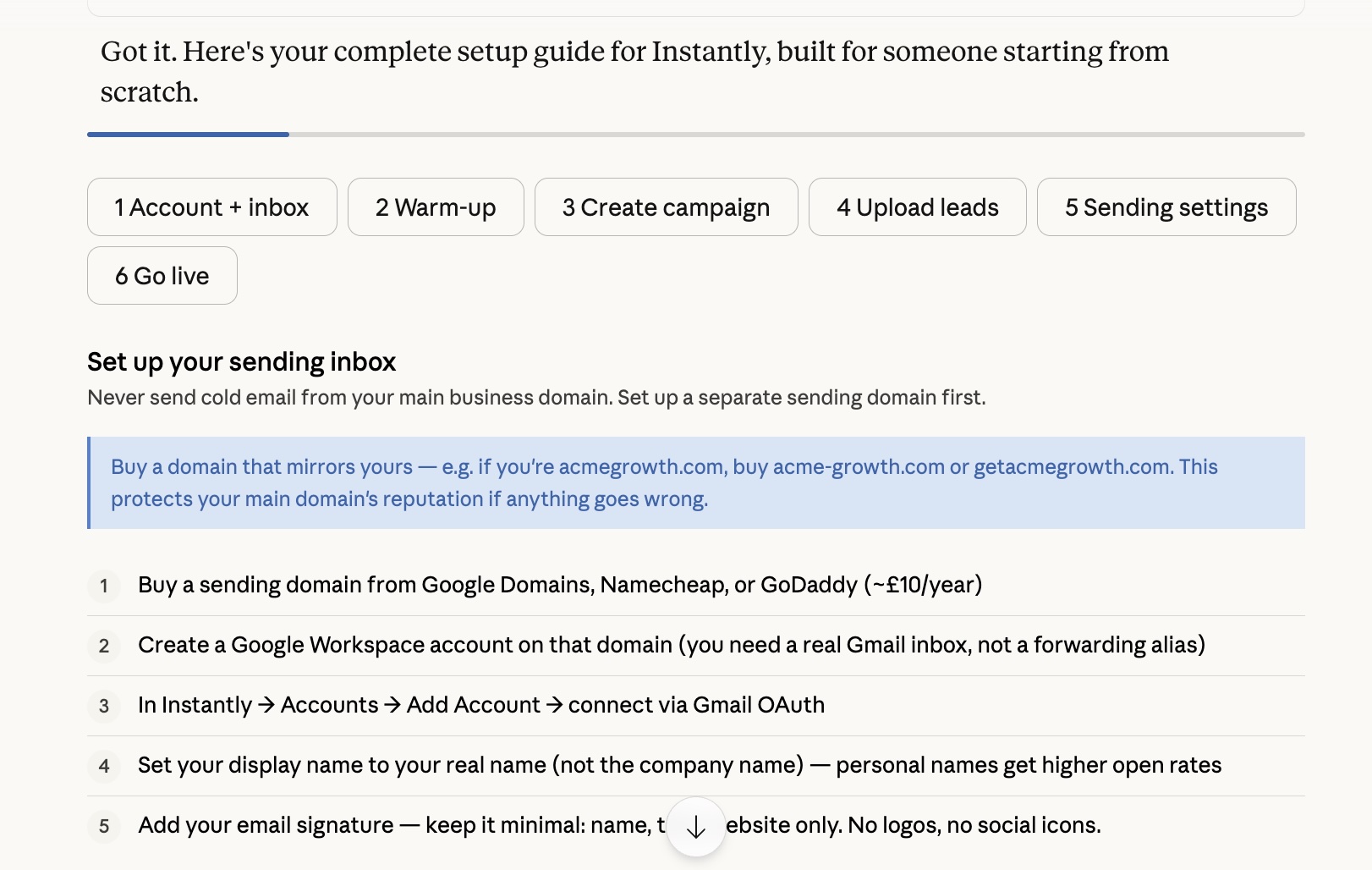
Claude will even ask which tool you’d like to set it up in, so it can provide you with step-by-step instructions. Pretty amazing, huh?
So now all you have to do is follow all the instructions you’ve been given. Unfortunately, Claude won’t do that for you. But think of it like a PA that can show you how to achieve your business objectives and you’ll be using Claude in the best way.
Things to think about
Whilst Claude is proving its value to guiding you through the marketing process, as a marketing consultant, I’d encourage you to add your intelligence layer over it, considering:
- Is the brand messaging right – will your target audience respond to it?
- Are the tools offered the best tools for you – consider the cost and ask for alternatives that may integrate with your business systems.
- Ask for evidence – challenge Claude in its suggestions and ask why it suggests one tool over another, and its rationale that its choice is best for you.
- Use your business instinct. You run a business, department or team because your instinct has put you as the best person for that role. Whilst AI platforms are useful, they have no instinct, they only use data.By combining data intelligence with your instinct you’ll find your most powerful combination.
